For the third marking period, I'm reading Inventology by Pagan Kennedy. Kennedy explores the various ways in which great inventors formulate ideas and how they make their ideas successful. In her introduction, Kennedy talks about how invention is necessary to create progress in society. Yet, in spite of its obvious utility, there are few resources for people seeking to make new products. Although we think of invention as a spontaneous and coincidental process, Kennedy's research disproves some of this idea. She believes that there is a methodical science to invention (hence the title of his book), and she wants Inventology to be a guide for future inventors. As a total control freak who hates leaving things to chance, Kennedy's proposals in Inventology were appealing to me, even if I'm not planning on inventing many things myself. Nevertheless, I'm hoping that, after reading Kennedy's book, I can pay more careful attention to the way in which I see the world. Maybe, somehow, I'll end up inventing something after all.
Saturday, January 30, 2016

Sunday, January 24, 2016
TOW #16 - Stiff (IRB)
In the course of reading this book, I've had a few people ask me what it's about. As if they can't tell from the cover image, I explain, "Cadavers." Sometimes they just change the topic from there.
I imagine that, as Roach wrote her book, she had to find a way to make her subject matter more palatable. While I do agree that cadaver research is fascinating, it is probably a rather small audience who feels this way. To make the storylines and information more appealing, Roach employs a narrative style of writing. Combined with primary documents, interviews with morticians, and descriptions of automobile crash tests, Roach's narratives bring a bit of life to her writing.
In one chapter, Roach discusses an experiment in which a researcher, Dr. Pierre Barbet, was determined to prove the authenticity of the Shroud, the cloth in which Jesus was wrapped for burial. Roach begins the chapter by writing, "The year was 1931. French doctors and medical students were gathered in Paris for an annual affair called the Laennec conference. Late one morning, a priest appeared on the fringes of the gathering. He wore the long black cassock and roman collar of the Catholic Church, and he carried a worn leather portfolio beneath one arm" (159). Roach's narrative works to draw the interests of a wider audience. For those who have no interest in cold science, or for those who are reluctant to read more about cadavers, narratives provide an easy transition into the subject. With such an opening, readers are able to familiarize themselves with the time and place, the people, and the questions at hand. They are not intimidated by scientific jargon or morbid descriptions. Rather, they are simply reading a story, one that happens to involve a doctor chopping off arms and nailing them to a makeshift cross--but nevertheless, a story.
As I said in my last post, I had a bit of trouble deciphering Roach's true purpose. There is always someone in English class who wonders, "What if the author just didn't care? And we're sitting here making stuff up?" While I've shared that same thought on occasion, I just don't think that's the case with Stiff. One doesn't take all the time and effort in researching and writing a book for no reason. I said last time that I believed Roach's purpose was to enlighten her audience with the contributions of cadavers to science. I maintain that view, as I believe the narrative style helped expose the wonders (and weirdness) that cadaver research has produced.
I imagine that, as Roach wrote her book, she had to find a way to make her subject matter more palatable. While I do agree that cadaver research is fascinating, it is probably a rather small audience who feels this way. To make the storylines and information more appealing, Roach employs a narrative style of writing. Combined with primary documents, interviews with morticians, and descriptions of automobile crash tests, Roach's narratives bring a bit of life to her writing.
In one chapter, Roach discusses an experiment in which a researcher, Dr. Pierre Barbet, was determined to prove the authenticity of the Shroud, the cloth in which Jesus was wrapped for burial. Roach begins the chapter by writing, "The year was 1931. French doctors and medical students were gathered in Paris for an annual affair called the Laennec conference. Late one morning, a priest appeared on the fringes of the gathering. He wore the long black cassock and roman collar of the Catholic Church, and he carried a worn leather portfolio beneath one arm" (159). Roach's narrative works to draw the interests of a wider audience. For those who have no interest in cold science, or for those who are reluctant to read more about cadavers, narratives provide an easy transition into the subject. With such an opening, readers are able to familiarize themselves with the time and place, the people, and the questions at hand. They are not intimidated by scientific jargon or morbid descriptions. Rather, they are simply reading a story, one that happens to involve a doctor chopping off arms and nailing them to a makeshift cross--but nevertheless, a story.
As I said in my last post, I had a bit of trouble deciphering Roach's true purpose. There is always someone in English class who wonders, "What if the author just didn't care? And we're sitting here making stuff up?" While I've shared that same thought on occasion, I just don't think that's the case with Stiff. One doesn't take all the time and effort in researching and writing a book for no reason. I said last time that I believed Roach's purpose was to enlighten her audience with the contributions of cadavers to science. I maintain that view, as I believe the narrative style helped expose the wonders (and weirdness) that cadaver research has produced.
Sunday, January 17, 2016
TOW #15 - It's Payback Time for Women (Written)
The op-ed "It's Payback Time for Women" by Judith Shulevitz proposes an interesting economic reform: paying every citizen of the United States a universal basic income (or UBI). The benefits of a UBI, Shulevitz argues, apply not just to the poor, but women as well. In order to convince her audience of a such a radical change, Shulevitz relies heavily on real-world examples and comparison and contrast, all of which appeal to the readers' logos.
To counteract the resistance against a seemingly preposterous idea, Shulevitz begins her piece by citing countries where a UBI already exists or is being seriously considered. In fact, her opening sentence pokes fun at her readers' skepticism, "A country that gives every citizen enough cash to live on whether she needs it or not: It’s got to be either a fool’s paradise or a profligate Northern European nation." Although lighthearted, Shulevitz begins delving into the places where a UBI does not seem so unrealistic: Finland, Switzerland, the Netherlands, and Canada. The beauty of such an opener is that it addresses a fundamental counterargument from the beginning: is a UBI even feasible? Shulevitz gives the subtle response: yes, it can be--and if it's not, at least there are other nations that think it's the worth the risk.
Yet another popular counterargument is that a UBI will lower people's motivation to work and only increase "laziness" in our society. Shulevitz acknowledges this and refutes, "The U.B.I. gives workers less reason to loll about at home than do perversely disincentivizing policies like the one whereby a dollar earned is a dollar cut from a welfare check. Research suggests that, rather than weaken the will to work, unconditional regular disbursements let people manage their careers more wisely." In this quote, Shulevitz contrasts the effects of a UBI on people versus a typical welfare benefit. Interestingly, Shulevitz also considers social welfare "disincentivizing," although her solution is simply to refine the distribution of welfare, not to cut it entirely. Such a comparison allows her readers to logically conclude that, if a moral society is to protect those in need, a UBI would be the most effective option.
Shulevitz' piece uses careful rhetoric with an amalgamation of quotes from social theorists, references to Silicon Valley, sociological research, and skillful refutation of her opponents' views. Her ideas are perhaps far too radical to win over her most staunchly conservative readers, regardless of her argument. Nevertheless, to a likeminded or neutral reader, her piece was logical and effective.
To counteract the resistance against a seemingly preposterous idea, Shulevitz begins her piece by citing countries where a UBI already exists or is being seriously considered. In fact, her opening sentence pokes fun at her readers' skepticism, "A country that gives every citizen enough cash to live on whether she needs it or not: It’s got to be either a fool’s paradise or a profligate Northern European nation." Although lighthearted, Shulevitz begins delving into the places where a UBI does not seem so unrealistic: Finland, Switzerland, the Netherlands, and Canada. The beauty of such an opener is that it addresses a fundamental counterargument from the beginning: is a UBI even feasible? Shulevitz gives the subtle response: yes, it can be--and if it's not, at least there are other nations that think it's the worth the risk.
Yet another popular counterargument is that a UBI will lower people's motivation to work and only increase "laziness" in our society. Shulevitz acknowledges this and refutes, "The U.B.I. gives workers less reason to loll about at home than do perversely disincentivizing policies like the one whereby a dollar earned is a dollar cut from a welfare check. Research suggests that, rather than weaken the will to work, unconditional regular disbursements let people manage their careers more wisely." In this quote, Shulevitz contrasts the effects of a UBI on people versus a typical welfare benefit. Interestingly, Shulevitz also considers social welfare "disincentivizing," although her solution is simply to refine the distribution of welfare, not to cut it entirely. Such a comparison allows her readers to logically conclude that, if a moral society is to protect those in need, a UBI would be the most effective option.
Shulevitz' piece uses careful rhetoric with an amalgamation of quotes from social theorists, references to Silicon Valley, sociological research, and skillful refutation of her opponents' views. Her ideas are perhaps far too radical to win over her most staunchly conservative readers, regardless of her argument. Nevertheless, to a likeminded or neutral reader, her piece was logical and effective.
Wednesday, January 6, 2016
TOW #14 - Brandalism in Paris (Visual)
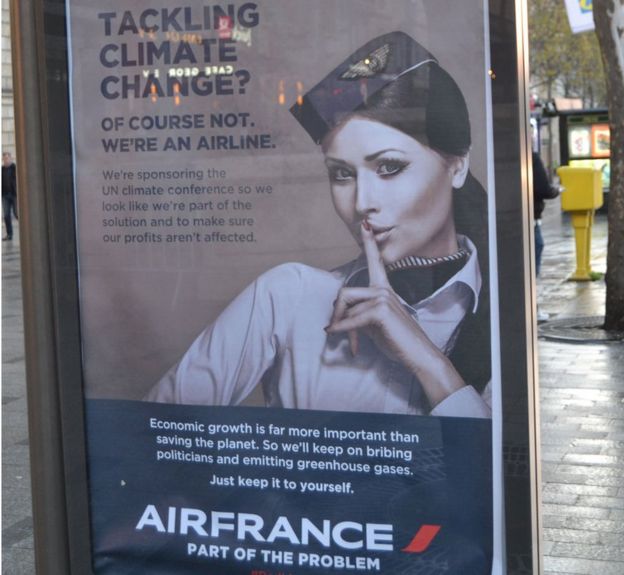 During the 2015 United Nations Climate Change Conference hosted in Paris, a subversive environmentalist group named Brandalism performed an "ad takeover." The purpose of their campaign was to highlight and criticize the negative environmental impacts made by large corporations. Brandalism used sarcasm to convey this purpose to their audiences, the general public of Paris and the globe. Their ad takeover included around 600 posters installed around the city focusing on different brands.
From afar, these ads appear to be normal displays for companies; however, upon closer examination, they criticize the non-action taken by corporations. The hypophora, "Tackling climate change?" is answered sarcastically with, "Of course not. We're an airline." In a smaller explanation, the ad reads, "We're sponsoring the UN climate conference so we look like we're part of the solution and to make sure our profits aren't affected." The expectation is for readers to be indignant about the airline's disingenuous actions and also to expose the more selfish motivations of corporations. When the ad jokes, "Economic growth is far more important than saving the planet," readers are supposed to disagree and view the corporation as an antagonist to climate change. The vertical progression of text from top to bottom parallels the progression of severity - from simply non-action to being "part of the problem." As the reader lingers on the ad, they feel increasingly cheated and lied to by the corporation.
Brandalism's efforts are clever by disguising their messages in everyday imagery and locations with which people are familiar. Although the ads make use of humor and sarcasm, they contain serious accusations against corporations. Hopefully, this makes readers more receptive to the messages Brandalism is sending. Furthermore, their methods are clever enough to make passersby consider the message for much longer than a few seconds.
Subscribe to:
Posts (Atom)