Inventology makes use of different inventors' stories to show to readers that inventions can come from anyone and anything. Kennedy's job is to parse who exactly comes up with inventions, how they do it, and, most importantly, how they were able to succeed. In order to truly show and not tell the secrets of inventology, Kennedy uses a narrative style of writing.
The stories of inventions are typically exciting because they are exactly that: stories. Our favorite inventions involve underdog heroes, who rise from humble beginnings to change the world or fantastical discoveries seemingly straight out of a sci-fi book. Kennedy understands the human desire to empathize with others and presents her various investors' storylines in a narrative style. The effect is to both keep readers interested, but also help them understand the lessons of inventology through inference. (The CPM method, if you will.)
This style of writing is effective at helping readers understand Kennedy's points, as well as for making an interesting reading experience.
Sunday, April 17, 2016

Thursday, April 7, 2016
TOW #23 - The Thrilling Uncertainty of the Understudy (Written)
"The Thrilling Uncertainty of the Understudy" by Rebecca Mead in The New York Times celebrates the often thankless work of understudies in Broadway productions. Using comparisons toward the conclusion of her article, Mead effectively champions the beauty of an understudy's performance.
Prompted by the appearance of an understudy's understudy in the Broadway production "Hamilton", Mead's article focuses on the musical's lesser known stars. She describes the first appearance of an understudy on stage, "When an unfamiliar actor steps into the light as Hamilton, the applause that greets him is scattered, more muted, as audience members rustle their Playbills for the overlooked white slip." The understudy is often unknown and perhaps even undesired, as people clamor to Broadway to see their favorite stars. However, Mead makes a daring comparison between the understudy and Hamilton himself, "The challenge that faces Hamilton, the character, as the play unfolds—how to make an impression against all expectations—is also the challenge that the actor confronts in playing him." Mead endows respect onto the work of the understudy by drawing this parallel.
Mead understands that her readers will respect the work "Hamilton," but perhaps not the work of the understudy. A comparison between the musical and the understudy is both thought-provoking and enlightening.
Prompted by the appearance of an understudy's understudy in the Broadway production "Hamilton", Mead's article focuses on the musical's lesser known stars. She describes the first appearance of an understudy on stage, "When an unfamiliar actor steps into the light as Hamilton, the applause that greets him is scattered, more muted, as audience members rustle their Playbills for the overlooked white slip." The understudy is often unknown and perhaps even undesired, as people clamor to Broadway to see their favorite stars. However, Mead makes a daring comparison between the understudy and Hamilton himself, "The challenge that faces Hamilton, the character, as the play unfolds—how to make an impression against all expectations—is also the challenge that the actor confronts in playing him." Mead endows respect onto the work of the understudy by drawing this parallel.
Mead understands that her readers will respect the work "Hamilton," but perhaps not the work of the understudy. A comparison between the musical and the understudy is both thought-provoking and enlightening.
Monday, March 28, 2016
TOW #22 - Investments (Visual)
While in London over spring break, I spotted an ad on the Underground system for making smart investments. The ad uses allusion to convince people to join an investment management company.
In the center of the ad, there is a quote from Variety Magazine, "Rock'n'roll will be gone by June." This quote, expressing an unusual sentiment, is from 1995. Readers are expected to be confused by this statement, as rock'n'roll is clearly still a lively genre. Following this example, the ad urges its viewers, "Do you put up with the status quo or are you looking for a better way to invest?" The company is using an allusion to a common genre to first draw readers' interests and then to exemplify the dangers of resisting change. It is implied that, if readers do not join this investment company, they too will be lost in the many changes coming in the near future.
Although this ad may use a logical fallacy (perhaps a false analogy), it is nevertheless attention-grabbing and effective at maintaining viewers' interests. Especially in an ad for a subway, space and both attention is limited. The puzzling and large quote convinces readers to pay attention to the company's message. Overall, the ad piques viewers' interests well and achieves its purpose fairly effectively.
In the center of the ad, there is a quote from Variety Magazine, "Rock'n'roll will be gone by June." This quote, expressing an unusual sentiment, is from 1995. Readers are expected to be confused by this statement, as rock'n'roll is clearly still a lively genre. Following this example, the ad urges its viewers, "Do you put up with the status quo or are you looking for a better way to invest?" The company is using an allusion to a common genre to first draw readers' interests and then to exemplify the dangers of resisting change. It is implied that, if readers do not join this investment company, they too will be lost in the many changes coming in the near future.
Although this ad may use a logical fallacy (perhaps a false analogy), it is nevertheless attention-grabbing and effective at maintaining viewers' interests. Especially in an ad for a subway, space and both attention is limited. The puzzling and large quote convinces readers to pay attention to the company's message. Overall, the ad piques viewers' interests well and achieves its purpose fairly effectively.
Sunday, March 13, 2016
TOW #21 - Stephen Colbert (Written)
Stephen Colbert is most widely known for his satire TV show The Colbert Report in which he plays an ultra-conservative TV host and mocks American politics. Colbert tends to stay in character while he is in the public eye, and, as such it can be hard for viewers to glean his actual political views. They understand that he is mocking right-wing politicians, but where do his views truly lie on the spectrum? Colbert delivers a fairly moderate message in a special article for Glamour magazine, in which he uses both humor and serious rhetorical questioning to advocate for a greater number of women in the public sphere.
Colbert's message is, although by no means radical or even groundbreaking, clearly intended to be feminist. It is well-known that Colbert is a white man, which could hurt his ethos to some readers. As a white man, it may be more difficult for Colbert to understand the complicated dynamics of sexism in the United States--and perhaps more difficult for him to address these issues without sounding condescending. Colbert uses self-deprecating humor to convey to his audience that he is aware of his privilege. He opens his piece by writing, "I want to thank the staff of Glamour for asking me to contribute. It's a nice consolation prize for being passed over for their Woman of the Year Award. Not that I wanted it anyway. I believe that honor should go to a woman. I'm a bit of a feminist that way." The sarcastic pat-on-the-back proves to readers that Colbert knows when he is overstepping. It is reassuring to readers that this will not be an article from a self-acclaimed mansplainer, but a genuine, honest feminist piece.
Aside from Colbert's humorous asides, he injects his piece with serious rhetorical questioning to address the issue at hand. He asks, "Where are all the lady blacksmiths? What about the bait-and-tackle shopkeepers, pool maintenance professionals, building superintendents, or CEOs of Fortune 500 companies? Why are all those minions shaped like tiny phalluses? Why did Mad Max get top billing in Fury Road when he was essentially just a grunting tripod for Charlize Theron's rifle?" Although some of the subject matter is silly (blacksmiths, pool maintenance professionals, etc.), Colbert manages to hit the pressing questions of the day. Where exactly are all the women? Even when they do get starring roles and high accomplishments, why are they pushed aside to make room for the men? Because Colbert is Colbert, he can't just ask these questions without injecting a little humor. But the thoughts the questions provoke are serious, and he implies the idea that women should be better represented and celebrated.
Colbert's message doesn't quite disturb the status quo to be revolutionary. Then again, it isn't intended to be revolutionary. Colbert is sharing a palatable message appealing to a broad audience, who can then go on and write their own revolutionary pieces. Colbert is just getting the ball rolling.
Colbert's message is, although by no means radical or even groundbreaking, clearly intended to be feminist. It is well-known that Colbert is a white man, which could hurt his ethos to some readers. As a white man, it may be more difficult for Colbert to understand the complicated dynamics of sexism in the United States--and perhaps more difficult for him to address these issues without sounding condescending. Colbert uses self-deprecating humor to convey to his audience that he is aware of his privilege. He opens his piece by writing, "I want to thank the staff of Glamour for asking me to contribute. It's a nice consolation prize for being passed over for their Woman of the Year Award. Not that I wanted it anyway. I believe that honor should go to a woman. I'm a bit of a feminist that way." The sarcastic pat-on-the-back proves to readers that Colbert knows when he is overstepping. It is reassuring to readers that this will not be an article from a self-acclaimed mansplainer, but a genuine, honest feminist piece.
Aside from Colbert's humorous asides, he injects his piece with serious rhetorical questioning to address the issue at hand. He asks, "Where are all the lady blacksmiths? What about the bait-and-tackle shopkeepers, pool maintenance professionals, building superintendents, or CEOs of Fortune 500 companies? Why are all those minions shaped like tiny phalluses? Why did Mad Max get top billing in Fury Road when he was essentially just a grunting tripod for Charlize Theron's rifle?" Although some of the subject matter is silly (blacksmiths, pool maintenance professionals, etc.), Colbert manages to hit the pressing questions of the day. Where exactly are all the women? Even when they do get starring roles and high accomplishments, why are they pushed aside to make room for the men? Because Colbert is Colbert, he can't just ask these questions without injecting a little humor. But the thoughts the questions provoke are serious, and he implies the idea that women should be better represented and celebrated.
Colbert's message doesn't quite disturb the status quo to be revolutionary. Then again, it isn't intended to be revolutionary. Colbert is sharing a palatable message appealing to a broad audience, who can then go on and write their own revolutionary pieces. Colbert is just getting the ball rolling.
Sunday, March 6, 2016
TOW #20 - Inventology (IRB) - ARGUMENT
In her book Inventology, Pagan Kennedy attempts to uncover the ways in which people invent things. Her hope is to create a guide that galvanizes future inventions. Inventology is the latest in the stream of psychology-esque books sparked by Malcolm Gladwell's writing. Gladwell has found success in making sense of the chaotic, linking together seemingly unrelated events with overarching themes. His successors have all attempted this, to varying to degrees of success. Kennedy takes a slightly different approach: she argues that there are various components, all equally important, that may lead to invention. However, this argument hinders her ultimate purpose of creating a guide for modern inventors. The various segments (e.g. "Problem Finding" and "Discovery") result in a sense of disjointedness and dissatisfaction.
Perhaps this is not so much Kennedy's fault, as it is the simple nature of invention. It is undeniable that sometimes serendipity leads to beautiful invention, and sometimes it is methodical data-mining that leads to the same beautiful invention. Nevertheless, it is somewhat dissatisfying for readers to constantly switch from one mindset to another. In one chapter, Kennedy emphasizes how inventions just arrive at certain people's feet. In another chapter, Kennedy discusses individuals' careful search for the Next Big Thing. Kennedy is not being disingenuous, but readers are forced to jump from one concept to another with no satisfying conclusions. It is like listening to an orchestra crescendo to nothing over and over again.
While I personally do not disagree with Kennedy's argument, the presentation leaves readers wanting. Perhaps if Kennedy were able to find connections between the various components of inventology, rather than completely segregating them, it would be more enjoyable to readers.
Perhaps this is not so much Kennedy's fault, as it is the simple nature of invention. It is undeniable that sometimes serendipity leads to beautiful invention, and sometimes it is methodical data-mining that leads to the same beautiful invention. Nevertheless, it is somewhat dissatisfying for readers to constantly switch from one mindset to another. In one chapter, Kennedy emphasizes how inventions just arrive at certain people's feet. In another chapter, Kennedy discusses individuals' careful search for the Next Big Thing. Kennedy is not being disingenuous, but readers are forced to jump from one concept to another with no satisfying conclusions. It is like listening to an orchestra crescendo to nothing over and over again.
While I personally do not disagree with Kennedy's argument, the presentation leaves readers wanting. Perhaps if Kennedy were able to find connections between the various components of inventology, rather than completely segregating them, it would be more enjoyable to readers.
Friday, February 26, 2016
TOW #19 - "Office Housework" (Written) - ARGUMENT
Women as mothers and caretakers have always been seen as a fundamental part of society. To some, it is only natural that women provide caring and empathetic counterpoints to stoic male dominance. In a four-part series for The New York Times, Facebook CEO Sheryl Sandberg and University of Pennsylvania professor Adam Grant dissect women's roles in the workplace. Sandberg, known for her book Lean In, promotes women actively taking leadership roles in the workplace. Additionally, she urges men to take on supportive roles and be more aware of difficulties for women. In the piece "Madam C.E.O., Get Me a Coffee," Sandberg and Grant argue that women do more work than men, but are somehow rewarded less. To present their points, Sandberg and Grant use a diverse array of research studies, expert opinions, and anecdotal evidence, which strengthens their argument.
Sandberg and Grant cite a study done by a New York University psychologist to appeal to their audience's logos. The study used objective measurements to present the differences in how people perceive their men and women co-workers. To explain why such discrepancies exist, Sandberg and Grant quote a Harvard professor, who observed that women do what is termed "office housework," administrative duties that often go unnoticed or unappreciated. Another study from a University of California Hastings professor supports this finding. All of these studies return to Sandberg and Grant's point that women are overworked in the workplace. It also makes their hotly debated argument more logical and objective.
In order to appeal to their audience's ethos, Sandberg and Grant also include anecdotes from women in the workplace. They use narrative to describe one woman's efforts, only for them to culminate in nothing. This source humanizes their argument and also provides a moment for readers to connect personally with the central claim.
Overall, Sandberg and Grant deliver a well-rounded array of sources to support their arguments.
Sandberg and Grant cite a study done by a New York University psychologist to appeal to their audience's logos. The study used objective measurements to present the differences in how people perceive their men and women co-workers. To explain why such discrepancies exist, Sandberg and Grant quote a Harvard professor, who observed that women do what is termed "office housework," administrative duties that often go unnoticed or unappreciated. Another study from a University of California Hastings professor supports this finding. All of these studies return to Sandberg and Grant's point that women are overworked in the workplace. It also makes their hotly debated argument more logical and objective.
In order to appeal to their audience's ethos, Sandberg and Grant also include anecdotes from women in the workplace. They use narrative to describe one woman's efforts, only for them to culminate in nothing. This source humanizes their argument and also provides a moment for readers to connect personally with the central claim.
Overall, Sandberg and Grant deliver a well-rounded array of sources to support their arguments.
Sunday, February 21, 2016
TOW #18 - Hamilton (Visual)
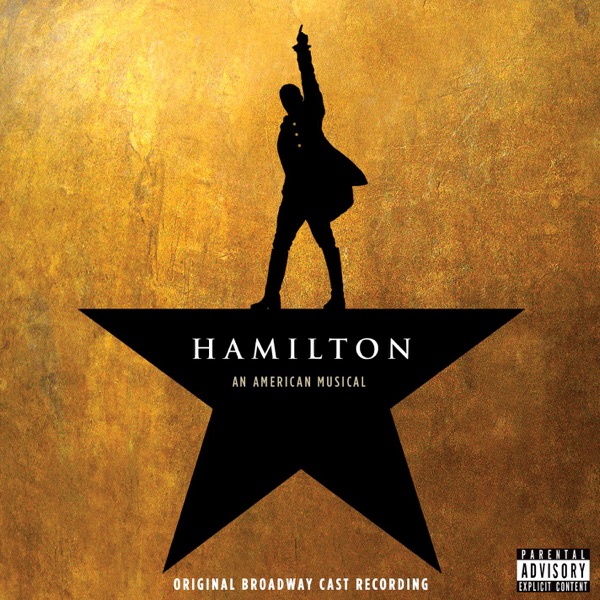
Hamilton, created by Lin Manuel Miranda, subverts the typical narrative of American history, which is so often populated by white men and their accomplishments. Both the cast and soundtrack resist the status quo of Broadway and society by including a nearly all people of color cast (quite fittingly, the only white man plays King George) that does almost the entire soundtrack in rap. Such changes provide new representation and nuance to Broadway. The revolutionary struggle of the American colonies takes on fresh meaning when played by people of color, who struggle against oppressive power structures in the 21st century as well. The album cover of the soundtrack reflects the musical's effort to bring people from the shadows into the spotlight.
Most biographies depict their subjects on the cover of their works. Interestingly, Hamilton does not depict a specific face or person. The silhouette of Hamilton on the front cover suggests an ambiguity about his person. Anybody, not just a white man, can be Hamilton. Anybody, not just a white man, can parallel his life story. This artistic choice introduces the subversive narrative in the lyrics of the soundtrack. Angelica Schuyler, sister of Hamilton's wife Eliza, sings, "You want a revolution? I want a revelation / So listen to my declaration / 'We hold these truths to be self-evident / that all men are created equal.' / And when I meet Thomas Jefferson / I'ma compel him to include women in the sequel." Hamilton is not a straight biography of the Founding Father, but includes plenty of editorializing to make the musical more reflective of the demand for social progress in the 21st century.
Additionally, the upper left hand corner of the cover mimics the lighting of a spotlight being cast on Hamilton. Like the silhouette, this also highlights a purpose of the musical: to shed new light (pun intended) on the Founding Father. In the musical, Angelica says, "Every other Founding Father's story gets told. Every other Founding Father gets to grow old." Hamilton and his contributions are not as well known as, say, Washington's or Jefferson's. The musical is intended to educate audiences about Hamilton's life and accomplishments. In doing so, they bring a man relegated to the backdrop into the foreground. The spotlight on the cover indicates the cast's intentions for the musical.
Most beautifully, Hamilton has reminded audiences that art can be found anywhere. Most Americans would never have though to be moved by a musical about a Founding Father. Yet, Hamilton takes people on an emotional journey of laughter and tears. No one would ever think to make a Broadway musical using rap either, but Miranda reminds us that artistic genius** lives in even the most hidden places. The simplicity of the album cover shows us that art can be found in any form, and it doesn't need a ton of flash. Passion, in any great work of art, speaks for itself. (Lin Manuel Miranda, if you're reading this, please send me two tickets to Hamilton.)
*If, at this point, you are wondering whether this is just going to be me gushing about how amazing Hamilton is, you're absolutely correct.
**If you think I'm exaggerating about artistic genius, take a look at this line from the song Washington on Your Side: "I'm sitting in the cabinet / complicit in watching him grabbin' at power and kissin' it / If Washington isn't gon' listen to disciplined dissidents / this is the difference / this kid is out."
Sunday, February 14, 2016
TOW #17 - Beyonce's Radical Halftime Statement (Written)
As one of the biggest events in the United States, the Superbowl always receives its fair share of appreciation and criticism. The halftime show, an ever growing spectacle, likes to be big, bold, and brash--but not anything beyond that. Highly politicized or controversial messages are often panned by the doughy faces of Fox News as inappropriate. However, this year, Beyonce performed her brand new song, "Formation," at the show with a slew of allusions to racial tensions in America. Her lyrics openly encourage the empowerment of black women. All this has, of course, drawn in criticism. But in "Beyonce's Radical Halftime Statement," Spencer Kornhaber argues that Beyonce's specific, targeted message is more far-reaching than one that operates on false pretenses of universality. To accomplish this, Kornhaber contrasts the performances of Beyonce and Bruno Mars at the Superbowl Halftime Show with the performance of Coldplay.
Using descriptive language, Kornhaber paints two wildly contrasting images of the halftime performance. He describes the Coldplay stage setup as "a legion of human Pikmin with flower-pedal umbrellas, a youth orchestra’s members playing tie-dyed violins, and Coldplay in the middle of it all, wearing white." Then, he said of the accompanying performers, "Both Beyoncé and Bruno wore black. They dressed the same as the people they stood shoulder to shoulder with...There was no racial subtext to this, just text. Mars’s crew was B-boying. Beyoncé’s was channeling black radical movements and Michael Jackson in 1993." In contrasting these two performances, Kornhaber emphasizes the weakness of one band in comparison to the strength of the other musical performers. With specific references to the events of the show, Korhnhaber demonstrates that Beyonce and Bruno Mars had genuine messages to convey. They were displaying pride for their own identities, racial or otherwise. Although their performances were almost militant in their uniform style, Kornhaber argues that they were more appealing in their authenticity than the bromides of Coldplay's.
Although Beyonce has one of the most dedicated legion of fans in the music industry, her work still faces criticism. Kornhaber's article is an important reminder that Beyonce's simple statement, "I slay," is a rebellion against the racism of American society. It is a message that everyone, especially young black women, need to hear. Such a subversion of power cannot be more appropriate for Middle America.
Using descriptive language, Kornhaber paints two wildly contrasting images of the halftime performance. He describes the Coldplay stage setup as "a legion of human Pikmin with flower-pedal umbrellas, a youth orchestra’s members playing tie-dyed violins, and Coldplay in the middle of it all, wearing white." Then, he said of the accompanying performers, "Both Beyoncé and Bruno wore black. They dressed the same as the people they stood shoulder to shoulder with...There was no racial subtext to this, just text. Mars’s crew was B-boying. Beyoncé’s was channeling black radical movements and Michael Jackson in 1993." In contrasting these two performances, Kornhaber emphasizes the weakness of one band in comparison to the strength of the other musical performers. With specific references to the events of the show, Korhnhaber demonstrates that Beyonce and Bruno Mars had genuine messages to convey. They were displaying pride for their own identities, racial or otherwise. Although their performances were almost militant in their uniform style, Kornhaber argues that they were more appealing in their authenticity than the bromides of Coldplay's.
Although Beyonce has one of the most dedicated legion of fans in the music industry, her work still faces criticism. Kornhaber's article is an important reminder that Beyonce's simple statement, "I slay," is a rebellion against the racism of American society. It is a message that everyone, especially young black women, need to hear. Such a subversion of power cannot be more appropriate for Middle America.
Saturday, January 30, 2016
IRB Intro #3 - Inventology
For the third marking period, I'm reading Inventology by Pagan Kennedy. Kennedy explores the various ways in which great inventors formulate ideas and how they make their ideas successful. In her introduction, Kennedy talks about how invention is necessary to create progress in society. Yet, in spite of its obvious utility, there are few resources for people seeking to make new products. Although we think of invention as a spontaneous and coincidental process, Kennedy's research disproves some of this idea. She believes that there is a methodical science to invention (hence the title of his book), and she wants Inventology to be a guide for future inventors. As a total control freak who hates leaving things to chance, Kennedy's proposals in Inventology were appealing to me, even if I'm not planning on inventing many things myself. Nevertheless, I'm hoping that, after reading Kennedy's book, I can pay more careful attention to the way in which I see the world. Maybe, somehow, I'll end up inventing something after all.
Sunday, January 24, 2016
TOW #16 - Stiff (IRB)
In the course of reading this book, I've had a few people ask me what it's about. As if they can't tell from the cover image, I explain, "Cadavers." Sometimes they just change the topic from there.
I imagine that, as Roach wrote her book, she had to find a way to make her subject matter more palatable. While I do agree that cadaver research is fascinating, it is probably a rather small audience who feels this way. To make the storylines and information more appealing, Roach employs a narrative style of writing. Combined with primary documents, interviews with morticians, and descriptions of automobile crash tests, Roach's narratives bring a bit of life to her writing.
In one chapter, Roach discusses an experiment in which a researcher, Dr. Pierre Barbet, was determined to prove the authenticity of the Shroud, the cloth in which Jesus was wrapped for burial. Roach begins the chapter by writing, "The year was 1931. French doctors and medical students were gathered in Paris for an annual affair called the Laennec conference. Late one morning, a priest appeared on the fringes of the gathering. He wore the long black cassock and roman collar of the Catholic Church, and he carried a worn leather portfolio beneath one arm" (159). Roach's narrative works to draw the interests of a wider audience. For those who have no interest in cold science, or for those who are reluctant to read more about cadavers, narratives provide an easy transition into the subject. With such an opening, readers are able to familiarize themselves with the time and place, the people, and the questions at hand. They are not intimidated by scientific jargon or morbid descriptions. Rather, they are simply reading a story, one that happens to involve a doctor chopping off arms and nailing them to a makeshift cross--but nevertheless, a story.
As I said in my last post, I had a bit of trouble deciphering Roach's true purpose. There is always someone in English class who wonders, "What if the author just didn't care? And we're sitting here making stuff up?" While I've shared that same thought on occasion, I just don't think that's the case with Stiff. One doesn't take all the time and effort in researching and writing a book for no reason. I said last time that I believed Roach's purpose was to enlighten her audience with the contributions of cadavers to science. I maintain that view, as I believe the narrative style helped expose the wonders (and weirdness) that cadaver research has produced.
I imagine that, as Roach wrote her book, she had to find a way to make her subject matter more palatable. While I do agree that cadaver research is fascinating, it is probably a rather small audience who feels this way. To make the storylines and information more appealing, Roach employs a narrative style of writing. Combined with primary documents, interviews with morticians, and descriptions of automobile crash tests, Roach's narratives bring a bit of life to her writing.
In one chapter, Roach discusses an experiment in which a researcher, Dr. Pierre Barbet, was determined to prove the authenticity of the Shroud, the cloth in which Jesus was wrapped for burial. Roach begins the chapter by writing, "The year was 1931. French doctors and medical students were gathered in Paris for an annual affair called the Laennec conference. Late one morning, a priest appeared on the fringes of the gathering. He wore the long black cassock and roman collar of the Catholic Church, and he carried a worn leather portfolio beneath one arm" (159). Roach's narrative works to draw the interests of a wider audience. For those who have no interest in cold science, or for those who are reluctant to read more about cadavers, narratives provide an easy transition into the subject. With such an opening, readers are able to familiarize themselves with the time and place, the people, and the questions at hand. They are not intimidated by scientific jargon or morbid descriptions. Rather, they are simply reading a story, one that happens to involve a doctor chopping off arms and nailing them to a makeshift cross--but nevertheless, a story.
As I said in my last post, I had a bit of trouble deciphering Roach's true purpose. There is always someone in English class who wonders, "What if the author just didn't care? And we're sitting here making stuff up?" While I've shared that same thought on occasion, I just don't think that's the case with Stiff. One doesn't take all the time and effort in researching and writing a book for no reason. I said last time that I believed Roach's purpose was to enlighten her audience with the contributions of cadavers to science. I maintain that view, as I believe the narrative style helped expose the wonders (and weirdness) that cadaver research has produced.
Sunday, January 17, 2016
TOW #15 - It's Payback Time for Women (Written)
The op-ed "It's Payback Time for Women" by Judith Shulevitz proposes an interesting economic reform: paying every citizen of the United States a universal basic income (or UBI). The benefits of a UBI, Shulevitz argues, apply not just to the poor, but women as well. In order to convince her audience of a such a radical change, Shulevitz relies heavily on real-world examples and comparison and contrast, all of which appeal to the readers' logos.
To counteract the resistance against a seemingly preposterous idea, Shulevitz begins her piece by citing countries where a UBI already exists or is being seriously considered. In fact, her opening sentence pokes fun at her readers' skepticism, "A country that gives every citizen enough cash to live on whether she needs it or not: It’s got to be either a fool’s paradise or a profligate Northern European nation." Although lighthearted, Shulevitz begins delving into the places where a UBI does not seem so unrealistic: Finland, Switzerland, the Netherlands, and Canada. The beauty of such an opener is that it addresses a fundamental counterargument from the beginning: is a UBI even feasible? Shulevitz gives the subtle response: yes, it can be--and if it's not, at least there are other nations that think it's the worth the risk.
Yet another popular counterargument is that a UBI will lower people's motivation to work and only increase "laziness" in our society. Shulevitz acknowledges this and refutes, "The U.B.I. gives workers less reason to loll about at home than do perversely disincentivizing policies like the one whereby a dollar earned is a dollar cut from a welfare check. Research suggests that, rather than weaken the will to work, unconditional regular disbursements let people manage their careers more wisely." In this quote, Shulevitz contrasts the effects of a UBI on people versus a typical welfare benefit. Interestingly, Shulevitz also considers social welfare "disincentivizing," although her solution is simply to refine the distribution of welfare, not to cut it entirely. Such a comparison allows her readers to logically conclude that, if a moral society is to protect those in need, a UBI would be the most effective option.
Shulevitz' piece uses careful rhetoric with an amalgamation of quotes from social theorists, references to Silicon Valley, sociological research, and skillful refutation of her opponents' views. Her ideas are perhaps far too radical to win over her most staunchly conservative readers, regardless of her argument. Nevertheless, to a likeminded or neutral reader, her piece was logical and effective.
To counteract the resistance against a seemingly preposterous idea, Shulevitz begins her piece by citing countries where a UBI already exists or is being seriously considered. In fact, her opening sentence pokes fun at her readers' skepticism, "A country that gives every citizen enough cash to live on whether she needs it or not: It’s got to be either a fool’s paradise or a profligate Northern European nation." Although lighthearted, Shulevitz begins delving into the places where a UBI does not seem so unrealistic: Finland, Switzerland, the Netherlands, and Canada. The beauty of such an opener is that it addresses a fundamental counterargument from the beginning: is a UBI even feasible? Shulevitz gives the subtle response: yes, it can be--and if it's not, at least there are other nations that think it's the worth the risk.
Yet another popular counterargument is that a UBI will lower people's motivation to work and only increase "laziness" in our society. Shulevitz acknowledges this and refutes, "The U.B.I. gives workers less reason to loll about at home than do perversely disincentivizing policies like the one whereby a dollar earned is a dollar cut from a welfare check. Research suggests that, rather than weaken the will to work, unconditional regular disbursements let people manage their careers more wisely." In this quote, Shulevitz contrasts the effects of a UBI on people versus a typical welfare benefit. Interestingly, Shulevitz also considers social welfare "disincentivizing," although her solution is simply to refine the distribution of welfare, not to cut it entirely. Such a comparison allows her readers to logically conclude that, if a moral society is to protect those in need, a UBI would be the most effective option.
Shulevitz' piece uses careful rhetoric with an amalgamation of quotes from social theorists, references to Silicon Valley, sociological research, and skillful refutation of her opponents' views. Her ideas are perhaps far too radical to win over her most staunchly conservative readers, regardless of her argument. Nevertheless, to a likeminded or neutral reader, her piece was logical and effective.
Wednesday, January 6, 2016
TOW #14 - Brandalism in Paris (Visual)
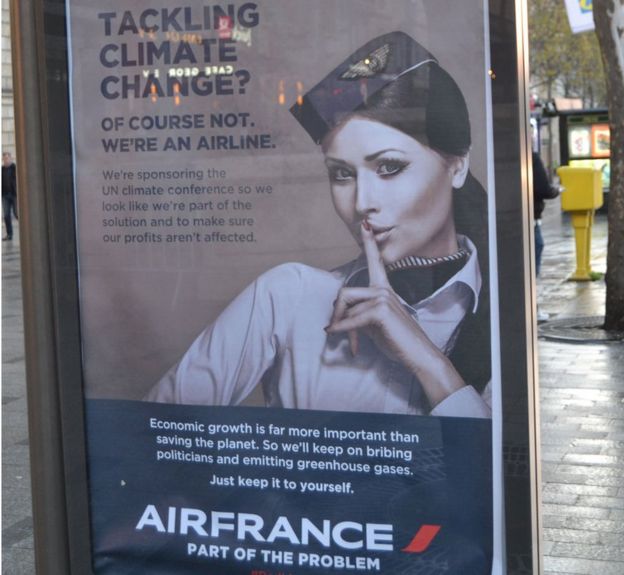 During the 2015 United Nations Climate Change Conference hosted in Paris, a subversive environmentalist group named Brandalism performed an "ad takeover." The purpose of their campaign was to highlight and criticize the negative environmental impacts made by large corporations. Brandalism used sarcasm to convey this purpose to their audiences, the general public of Paris and the globe. Their ad takeover included around 600 posters installed around the city focusing on different brands.
From afar, these ads appear to be normal displays for companies; however, upon closer examination, they criticize the non-action taken by corporations. The hypophora, "Tackling climate change?" is answered sarcastically with, "Of course not. We're an airline." In a smaller explanation, the ad reads, "We're sponsoring the UN climate conference so we look like we're part of the solution and to make sure our profits aren't affected." The expectation is for readers to be indignant about the airline's disingenuous actions and also to expose the more selfish motivations of corporations. When the ad jokes, "Economic growth is far more important than saving the planet," readers are supposed to disagree and view the corporation as an antagonist to climate change. The vertical progression of text from top to bottom parallels the progression of severity - from simply non-action to being "part of the problem." As the reader lingers on the ad, they feel increasingly cheated and lied to by the corporation.
Brandalism's efforts are clever by disguising their messages in everyday imagery and locations with which people are familiar. Although the ads make use of humor and sarcasm, they contain serious accusations against corporations. Hopefully, this makes readers more receptive to the messages Brandalism is sending. Furthermore, their methods are clever enough to make passersby consider the message for much longer than a few seconds.
Subscribe to:
Posts (Atom)