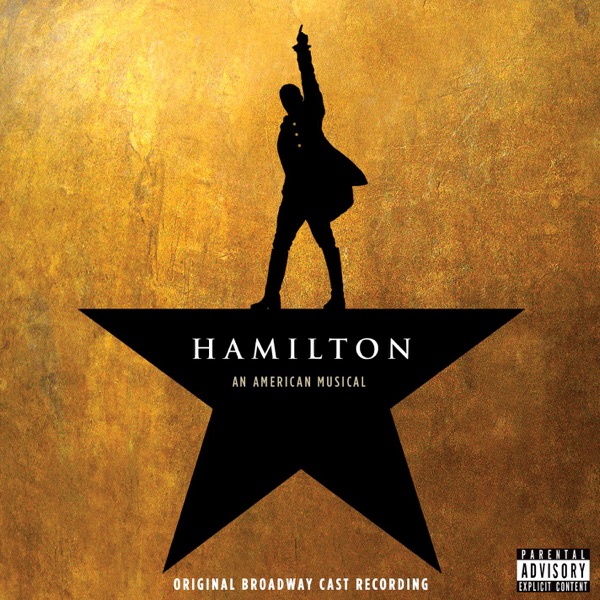
Hamilton, created by Lin Manuel Miranda, subverts the typical narrative of American history, which is so often populated by white men and their accomplishments. Both the cast and soundtrack resist the status quo of Broadway and society by including a nearly all people of color cast (quite fittingly, the only white man plays King George) that does almost the entire soundtrack in rap. Such changes provide new representation and nuance to Broadway. The revolutionary struggle of the American colonies takes on fresh meaning when played by people of color, who struggle against oppressive power structures in the 21st century as well. The album cover of the soundtrack reflects the musical's effort to bring people from the shadows into the spotlight.
Most biographies depict their subjects on the cover of their works. Interestingly, Hamilton does not depict a specific face or person. The silhouette of Hamilton on the front cover suggests an ambiguity about his person. Anybody, not just a white man, can be Hamilton. Anybody, not just a white man, can parallel his life story. This artistic choice introduces the subversive narrative in the lyrics of the soundtrack. Angelica Schuyler, sister of Hamilton's wife Eliza, sings, "You want a revolution? I want a revelation / So listen to my declaration / 'We hold these truths to be self-evident / that all men are created equal.' / And when I meet Thomas Jefferson / I'ma compel him to include women in the sequel." Hamilton is not a straight biography of the Founding Father, but includes plenty of editorializing to make the musical more reflective of the demand for social progress in the 21st century.
Additionally, the upper left hand corner of the cover mimics the lighting of a spotlight being cast on Hamilton. Like the silhouette, this also highlights a purpose of the musical: to shed new light (pun intended) on the Founding Father. In the musical, Angelica says, "Every other Founding Father's story gets told. Every other Founding Father gets to grow old." Hamilton and his contributions are not as well known as, say, Washington's or Jefferson's. The musical is intended to educate audiences about Hamilton's life and accomplishments. In doing so, they bring a man relegated to the backdrop into the foreground. The spotlight on the cover indicates the cast's intentions for the musical.
Most beautifully, Hamilton has reminded audiences that art can be found anywhere. Most Americans would never have though to be moved by a musical about a Founding Father. Yet, Hamilton takes people on an emotional journey of laughter and tears. No one would ever think to make a Broadway musical using rap either, but Miranda reminds us that artistic genius** lives in even the most hidden places. The simplicity of the album cover shows us that art can be found in any form, and it doesn't need a ton of flash. Passion, in any great work of art, speaks for itself. (Lin Manuel Miranda, if you're reading this, please send me two tickets to Hamilton.)
*If, at this point, you are wondering whether this is just going to be me gushing about how amazing Hamilton is, you're absolutely correct.
**If you think I'm exaggerating about artistic genius, take a look at this line from the song Washington on Your Side: "I'm sitting in the cabinet / complicit in watching him grabbin' at power and kissin' it / If Washington isn't gon' listen to disciplined dissidents / this is the difference / this kid is out."

No comments:
Post a Comment